No, this is not normal
Friday Roundup for May 15, 2026

In a brand-new episode of our “Stuck in the Middle with You” podcast, Ben Cole and I discuss this weekend’s upcoming events on the National Mall in Washington, the Trump administration’s “Rededicate 250” rally. As you might imagine, we see this thing quite differently.
At BNG, we’ve also written a lot about this already and will have more next week, as our Rick Pidcock will be in attendance at Sunday’s day-long rally.
To get up to speed, start here:
One nation under which God? by Warren Throckmorton
When government claims God by Amanda Tyler
Is pluralism possible under an evangelical Christian God? by Rick Pidcock
In my podcast conversation with Ben, after I call him a “smug conservative” who routinely makes fun of people who disagree with him, he challenges me — being older — to think back to how our nation celebrated the bicentennial in 1976.
For the record, I was 14 years old in the summer of 1976. And yes, I do remember some parts of the bicentennial but other things I had to look up. The weirdest memory that popped in my head was that the family of one of my best childhood friends had made a trip to Washington, D.C., in 1976 and brought back bicentennial drinking glasses — sort of old-fashioned glass mugs with patriotic decorations embossed all around. Every celebration needs kitsch.
My strongest memories are tied to music, however. The year before, in anticipation of the bicentennial, our little middle school show choir had traveled all over town singing a patriotic program dressed in red, white and blue uniforms that included a weird 1970s-era scarf. I can still hear the melody of one song that began, “Connecticut, are you for independence? Are you for life and liberty?”
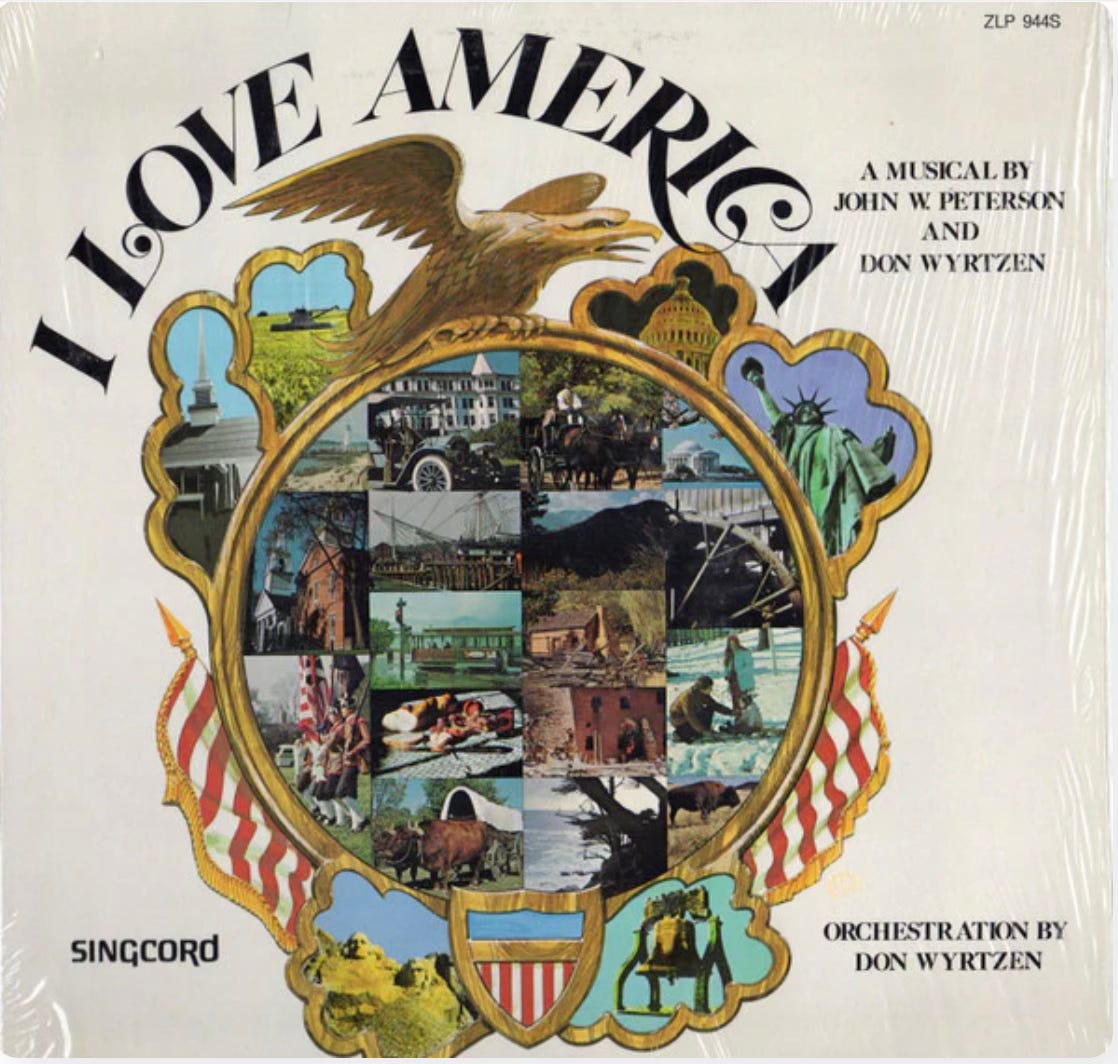
But the bigger production happened at First Baptist Church, where our minister of music put on an all-skate that included the Youth Choir and Sanctuary Choir and anyone else passing by in a production of a brand-new musical called I Love America! It was written by John W. Peterson and Don Wyrtzen.
Now, if you know anything about 1970s church music, you’ll immediately recognize those were two big names in the biz. The musical was published by Singspiration, another powerhouse publisher of the day.
Songs in this flag-waving musical for church choirs include: “I’m Just A Flag-Waiving American,” “In God We Trust,” “America the Beautiful,” “God of Our Fathers,” “Praise the Lord and Give Thanks, America,” “It’s Time to Pray,” “If My People” and “Jesus Is Calling America.”
The musical ends with a rousing rendition of “Battle Hymn of the Republic.”
“We were Christian nationalists before anyone ever used that term.”
As I’ve said before, we were Christian nationalists before anyone ever used that term. That’s just the way things were in Oklahoma. At church, we mixed church and state freely. I did not learn about the Constitutional separation of church and state until I was in college.
However, challenged by Ben to look at how the nation celebrated the bicentennial, I turned to the internet for help. Here’s what I learned: While churches like ours celebrated the nation’s founding, the federal government did not sponsor religious events. Even though a Republican, Gerald Ford, was president. Of course, in those days being a Republican meant something quite different than today.
Here’s what Google told about the bicentennial celebrations:
Churches across the U.S. held 1776-style worship, rang bells and conducted community picnics. There were interfaith services and special masses, notably a “Thanksgiving Mass” on Patriots Day in Boston. The American Bible Societyencouraged churches to join in ringing bells on July Fourth for two minutes to honor the ringing of the Liberty Bell.
More than 1,000 religious events were reported, including a cross-country Christian “wagon train.” These were not sponsored by the government, however.
What the Trump administration has planned for this semiquincentennial is much different. It begins and ends with the false notions that America was founded as a “Christian nation” and that evangelical Christians should have special privileges.
Had Gerald Ford attempted in 1976 what Donald Trump is doing in 2026, both Republicans and Democrats would have come out of the woodwork to condemn it. But now, 50 years later, conservative evangelicals have gained the political power they so craved and are rewriting our national history.
Listen to the podcast and you’ll hear Ben and me take opposite sides on this question, with him contending the majority of the Founders were Christians and therefore envisioned a Christian-influenced government. My position is that the Founders were Christians and theists — none of them like today’s evangelicals — who purposely chose not to enshrine religion in government.
Christian nationalists and conservative evangelicals want us to believe what the Trump administration is doing is normal, but it is not. It is abnormal. And it is wrong.
I love this line from Amanda Tyler: “When governments claim the mantle of God, they find perdition instead of salvation.”
Yes, Christians can and should be patriotic. But government must not — according to the First Amendment — endorse any one religion over others and must not “establish” religious practice.
“We cannot ‘rededicate’ America to God because the nation never was ‘dedicated’ to God in the first place.”
We cannot “rededicate” America to God because the nation never was “dedicated” to God in the first place. To claim otherwise is revisionist history that serves only one purpose: To justify the political power grab evangelicals want to maintain.
When you see church and state merge, it’s never to the advantage of the church. It’s always about controlling the state.
What would be a more appropriate way of celebrating America’s 250 years of existence? Showcasing the very things MAGA doesn’t want to talk about: The rich stream of diverse people who have shaped our country, the struggle for freedom, a celebration of education, the arts, science and medicine and more.
But the Trump administration is seeking to dismantle all those things: They’re against diversity and inclusion, they’re against education, they’re don’t want to talk about slavery, they want to send away all immigrants, they want to rebrand the arts with Trump’s name, they don’t believe in science, and they question common-sense medical truth. No wonder they’re left worshiping a god of their own making.
Which brings us to Doral, Fla., where Pastor Mark Burns recently prayed over and dedicated a golden statue of Trump that looks a whole lot like that golden statue of Nebuchadnezzar described in Daniel chapter 3. Stephen Shoemakersays Daniel and his three friends would like a word.
As our Steve Rabey documented this week, that’s just one of many ways Trump is branding America in his image.
Likewise, evangelicals are trying to brand the nation in their image, which is what Sunday’s events are all about. And no, this is not normal.
If you want to know where this leads, look no further than Robert Jeffress, who without flinching proclaimed last week that Trump understands the Bible better than Pope Leo.
Page 2
We write every week about how American democracy is threatened by the Trump administration — which functions more like an autocracy. The dangers are real and cannot be laughed off.
U.S. Rep. Alexandria Ocasio-Cortez showed up last Sunday at Ebenezer Baptist Church in Atlanta and spoke about faith and the Voting Rights Act.
Likewise, Edmond Davis writes about the “failed narrative” of Louisiana Gov. Jeff Landry when it comes to voter suppression.
The Trump administration has proposed a new rule that could devastate Christian higher education by tying student loans to the earning potential of degree programs. Charlie Fuller, a former dean of fine arts at a Baptist university, writes to explain the inherent stupidity in such a federal rule that fails to comprehend the reason for education.
Cynthia Astle writes about how democracy’s decline is having a bad influence on The United Methodist Church.
A faith-based advocacy network has launched a tour of six red states where overwhelmed activists need encouragement and support in opposing Christian nationalism.
On a happier note, David Gushee points out some ways the guardrails of democracy are still working. Steve Rabey adds to that with a report on how courts are sometimes pushing back on Trump’s vengeance campaign against his enemies.
And a group led by a 19-year-old is pushing back against Turning Point USA by forming campus chapters of a group called Dream for America.
Page 3
This week marked the 10th anniversary of BNG publishing my column on seeking to understand transgender people. I heard last night from the mother of the 8-year-old girl I mentioned in my TEDx Talk that resulted from that column. Claire is now 18 and about to graduate from high school.
Hearing about that graduation was wonderful news. And it reminded me that most trans folk seek to live normal lives and just want to be left alone. None of them seeks the publicity our fearful politicians seem to desire.
Liam Gent and I co-authored a piece this week to mark the 10-year anniversary of our friendship, which began with that BNG column. We also recorded a podcast with Ben Cole yesterday that will drop next week.
One of the things we talk about is how much harder it is to be a transperson today than it was 10 years ago. As evidence of that, read this article about how the Trump administration has labeled transgender people a national security threat on par with drug cartels and Islamic militant groups.
Page 4
In other news this week:
A Tarrant County, Texas, jury awarded Southwestern Baptist Theological Seminary $7.1 million in damages from its insurer, related to the case brought by Jane Roe against the seminary and its former president, Paige Patterson.
Caroline Cook has been named a Clemons Fellow with Baptist News Global for the summer. She has just completed her freshman year at Baylor University and is exploring a career in communications.
Nationals from 10 African countries face the steepest barriers to entering the U.S. for business, study, tourism or residency, according to a new study by a Florida law firm specializing in immigration.
The Southern Poverty Law Center pleaded not guilty to 11 fraud-related charges and is tentatively set to face trial Oct. 5 in an Alabama federal court.
Joe White, the embattled leader of Kamp Kanakuk in Missouri, will retire at the end of this summer’s camping season, he announced. That does not mean he will relinquish ownership of the camp, however.
No More Victims Alliance launched a new advocacy campaign called “Against the Clock” in response to the stalling of two statute of limitations reform bills in Missouri. Patrick Marsh, whose daughter died at Camp Mystic, writes about why reform is needed in Missouri.
Page 5
In other analysis and opinion this week:
Joe Marlow says the St. Ives Riddle illustrates the challenge of understanding moral imagination.
David Bumgardner explains how a 2024 court ruling set the stage for The United Methodist Church to escape liabilityfor clergy sexual abuse.
Rodney Kennedy reviews a new book titled Putin’s Altar Boy.
Based on his work in disaster relief, Gregory C. Smith explains how some wounds are spiritual before they are emotional.
Brad Bull writes about the journey with his father through a terminal diagnosis.
Ben Norquist says understanding Nakba Day could help Americans understand the plight of Palestinians.
Bobby Smith and Mary Frances Phillips draw from the past to advise how to survive a “skinny” farm bill with creativity and action.
Amanda Smith tells about the joy of co-preaching a sermon with a 10-year-old girl.
Josh Olds makes a case for why Tanner Horner — although clearly guilty of a heinous crime — should not be executed by the state.
A final word
I want to preview for you a new project coming soon from BNG. As the United States approaches its 250th anniversary, BNG, in partnership with Carol McEntyre, is developing a series to help congregations reflect on the relationship between Christianity and democratic life.
At a time when many Christians feel exhausted, cynical, or unsure how faith speaks into public life anymore, this series will offer thoughtful, theologically grounded perspectives for churches and small groups.
Look for the series to being the first week of June.
For now, blessings for your weekend ahead. And thanks for reading and for supporting our work.
Mark Wingfield
Executive Director and Publisher
Baptist News Global